
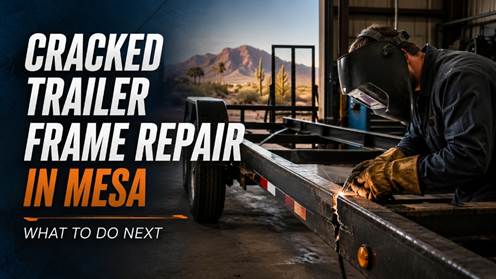
A crack in a trailer frame can begin as a thin line near a weld, spring hanger or crossmember. It may be easy to dismiss when the trailer still sits level and tows normally. The problem is that a frame carries changing loads whenever the trailer accelerates, turns, brakes or crosses uneven pavement. A small defect can continue spreading under repeated stress.
The right repair depends on where the crack started, how far it has traveled and whether the surrounding metal remains strong.
Stop and Identify the Damaged Area
Do not cover the crack with paint or attempt a quick surface weld before it has been assessed. Clean loose dirt from the area and take photographs. Note whether the damage is on a main frame rail, tongue, crossmember, ramp support, spring hanger or coupler mounting area.
Cracks near the tongue, coupler, suspension or main rails deserve immediate attention because those parts carry major towing loads. A bent, sagging or twisted frame should not be towed until a qualified repair professional has inspected it.
Look Beyond the Visible Crack
The opening you can see may not show the full problem. A welder will examine the crack length, surrounding welds, frame alignment and metal condition. Rust, previous repairs and deformation can change the recommended approach.
The inspection should also consider why the crack formed. Overloading, uneven cargo, a hard impact, worn suspension parts or poor alignment may concentrate stress in one area. Closing the visible line without correcting the cause can allow the damage to return beside the new weld.
Can a Cracked Trailer Frame Be Welded?
Many trailer frame cracks can be repaired, but not every frame should be welded. The damaged area must be prepared correctly, and the method has to match the frame material, thickness and location.
A professional repair may involve removing damaged metal, opening and cleaning the crack, restoring alignment and welding the joint with the appropriate process. A reinforcement plate or gusset may be added when the structure needs help distributing the load.
Welding over dirt, paint, rust or a narrow surface crack is not a lasting solution. The condition of the base metal matters as much as the weld.
When Replacement May Make More Sense
Repair may not be practical when corrosion has thinned a large section of the frame, several cracks are present or the trailer is badly twisted. Extensive damage can require replacement of a complete rail, tongue section or crossmember.
The trailer’s age, value and intended load also matter. A repair that is reasonable for a commercial equipment trailer may not make financial sense on a lightly built trailer with widespread deterioration. A reputable shop should explain whether repair, section replacement or trailer replacement is the safer choice.
Inspect Related Trailer Components
Frame damage may be connected to another problem. Check the axles, springs, hangers, equalizers, coupler, safety chains and tires. Uneven tire wear or a trailer that pulls to one side may point to alignment or suspension trouble.
CURT recommends inspecting the trailer frame for cracks or damage as part of regular maintenance. It also advises checking the hitch, coupler, safety chains, brakes, suspension and axles. Finding a worn component early may prevent another failure after the welding work is complete.
Shop Repair or Mobile Welding
A trailer that is unsafe to tow may need mobile welding or transport by another method. Smaller repairs can sometimes be completed at the trailer’s location. More extensive structural work is often better handled in a shop where the frame can be supported, measured and aligned with suitable equipment.
Provide photographs, the trailer type, approximate dimensions and a description of what happened when requesting service. This helps the shop decide whether mobile work is appropriate.
Schedule Trailer Frame Repair With Cliff’s Welding
Cliff’s Welding provides trailer frame repair, structural welding, axle service, hitch repair, custom fabrication and mobile welding throughout Mesa and the Phoenix Valley. The team works on utility, boat, horse, cargo, equipment, car and commercial trailers. If you find a crack, bent section or failed weld, call 480-832-0570 to arrange an inspection before the damage becomes more difficult to repair.
References
Cliff’s Welding: Trailer Repair
Cliff’s Welding: Repair Services
Cliff’s Welding: Mobile Welding Service
CURT: A Comprehensive Guide to Trailer Maintenance
National Highway Traffic Safety Administration: Check for Recalls