When Should a Trailer Hitch Be Repaired or Replaced?
A trailer hitch works in a difficult location. It sits beneath the vehicle or at the front of the trailer, where it faces road debris, vibration, heavy loads and occasional contact with curbs or uneven ground. Gradual wear can therefore be easy to overlook.
Some problems can be corrected with replacement hardware or professional repair. Others require the hitch or receiver to be replaced. The answer depends on which component is damaged, how it was manufactured and whether its original strength and rating can be preserved.
Inspect After an Impact
Stop and inspect the towing system after the hitch, ball mount, trailer tongue or jack strikes the road. A severe pothole, steep driveway or backing accident can bend a component even when the damage is not immediately obvious.
Look at the receiver from behind and from the side. A shifted position, unusual angle or new gap between the hitch and vehicle frame deserves attention. Reese guidance for fifth wheel equipment advises a thorough inspection after any part of the towing system strikes the road.
Watch for Movement and Noise
A ball mount has some clearance inside a receiver, but new clunking, rattling or visible movement should not be dismissed. Check the hitch pin, clip, ball mount, coupler and mounting points.
Do not tighten every fastener by feel. Hitch hardware has specified locations and torque requirements. Draw Tite instructions tell owners to check periodically that fasteners remain tight and the hitch is securely mounted. A professional installer can identify the correct specification for the exact hitch.
Separate Surface Rust From Structural Corrosion
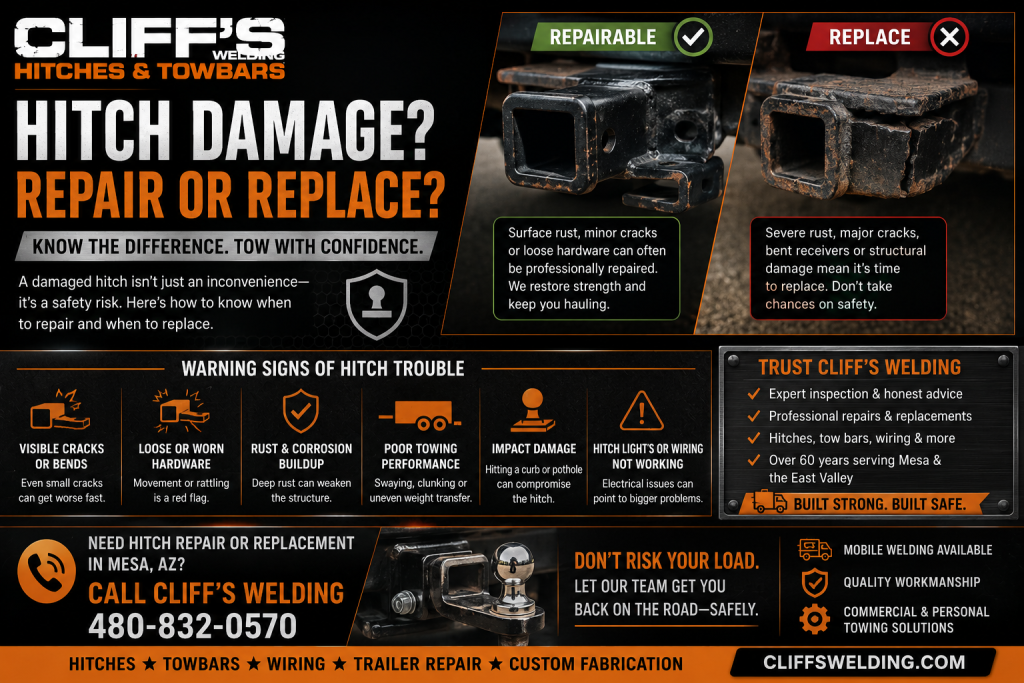
Light surface rust may affect appearance without meaning the hitch has lost its capacity. Deep scaling, flaking metal, swelling around joints or significant material loss is different.
Pay particular attention to welds, mounting plates, the receiver opening and places where debris collects. Rust can also hide a crack. Painting over heavy corrosion before assessment only conceals the evidence.
Look for Cracks, Bends and Enlarged Holes
Hairline cracks often begin beside welds, corners or holes where stress is concentrated. A bent receiver tube, distorted coupler, stretched hitch pin hole or cracked mounting bracket can change the way towing loads enter the vehicle or trailer.
Do not test suspected damage by towing a lighter load. The component may behave differently under braking, cornering or highway vibration. Remove it from service until a qualified shop has examined it.
Know Which Parts Should Not Be Welded
A vehicle specific receiver hitch is an engineered product with a stated rating. Manufacturer instructions commonly warn owners not to cut, weld or modify the receiver. Draw Tite also states that a damaged hitch or ball should be removed and replaced.
Trailer tongues, frames, brackets and custom fabricated parts may sometimes be repaired after the damage and surrounding structure have been evaluated. A professional should decide whether repair can restore safe function or replacement is necessary. Cliff’s confirms that its trailer services include structural repairs, hitch repair and complete hitch replacement.
Recheck the Rating for Your Current Trailer
A hitch may be undamaged and still be wrong for the job. Compare the tow vehicle rating, receiver rating, ball mount, hitch ball and loaded trailer weight. The safe limit is controlled by the lowest rated part of the system.
If the trailer, cargo or tow vehicle has changed, tell the installer. The better solution may be a different hitch class, weight distribution system, gooseneck or fifth wheel setup.
Bring Useful Information to the Shop
Record the vehicle year, make and model, trailer type and expected loaded weight. Photograph the hitch from several angles and note any impact, unusual noise or change in towing behavior.
Do not attempt a temporary weld before inspection. Seeing the original damage helps the shop determine what happened and which surrounding parts should also be checked.
Arrange Trailer Hitch Repair in Mesa
Cliff’s Welding repairs and replaces trailer hitches, receivers, trailer frames and related towing components from its Mesa shop, with mobile welding available for equipment that cannot be moved safely. The team also installs receiver, gooseneck, fifth wheel and weight distribution hitches. Call 480 832 0570 to have a damaged or questionable hitch inspected before it returns to the road.
References
Cliff’s Welding Trailer Repair
Cliff’s Welding Hitch Installation
Draw Tite Receiver Hitch Safety Instructions